Research

Research Projects
Integrating Optimal Function and Compliant Mechanisms for Ubiquitous Lower-Limb Powered Prostheses
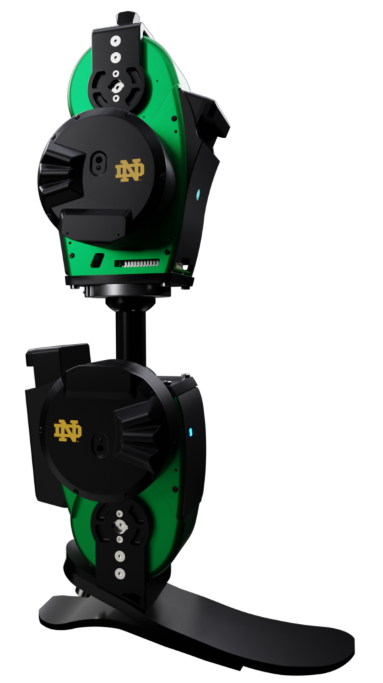
The majority of lower-limb prostheses are passive. They can dissipate and store mechanical power but cannot generate positive net power. The lack of power generation limits movements that require the user to move against gravity, such as going upstairs or transitioning from sitting to standing. This lack of power may induce uneven loads in the body, which can increase the likelihood of chronic back pain and increase the effort to walk. Active prostheses have the potential to overcome these fundamental challenges. However, commercially available powered prostheses are heavier, noisier, more expensive, and generally less accessible than unpowered versions. The overall goal of this project is to reimagine existing rigid prosthetic components as compliant mechanisms that reduce mass, energy consumption, audible noise, and part count of powered prostheses. Muscles take advantage of the elasticity of tendons (in series with the muscle) and ligaments (in parallel with the muscle) to efficiently transfer power from the muscle to the joints. This project will provide a new understanding of how to engineer elastic components in parallel with electric motors as engineered ligaments to make powered prostheses more attractive and accessible.
Researchers
Collaborators in compliant mechanisms and robotic actuation
- Larry Howell Ph.D., Nathan Usevitch Ph.D., et al. -- Brigham Young University.
Sponsor

This material is based upon work supported by the National Science Foundation under Grant No. (2344765 and 2344766). Any opinions, findings, and conclusions or recommendations expressed in this material are those of the author(s) and do not necessarily reflect the views of the National Science Foundation.
Towards Physical-Interface Pressure Monitoring Outside the Laboratory with Lower-Limb Electronic Clothing and Robust Optimization
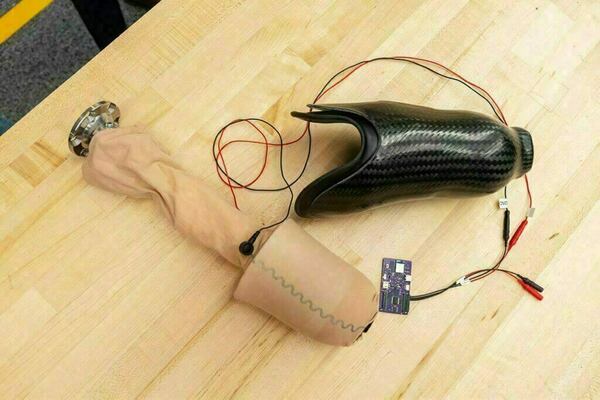
The health outcomes of using a prosthesis and orthosis depend on the physical interface between compliant human tissue and the rigid or padded structures of the device. There is a fundamental gap in knowledge about how to characterize interface pressures outside the clinic and the laboratory without expert sensor calibration and placement. This project will enable the accurate measurement of interface pressure for more than 16 continuous hours without expert supervision to provide quantifiable data for the design of comfortable prosthetic sockets and orthoses.
Researchers
Collaborators in electronic textiles
Chi Hwan Lee, Ph.D., and Tianhao Yu -- Purdue University.
Sponsor

Research reported in this publication was supported by the National Institute Of Biomedical Imaging And Bioengineering of the National Institutes of Health under Award Number 1R21EB034879. The content is solely the responsibility of the authors and does not necessarily represent the official views of the National Institutes of Health.
Control of Lower-Limb Wearable Robots
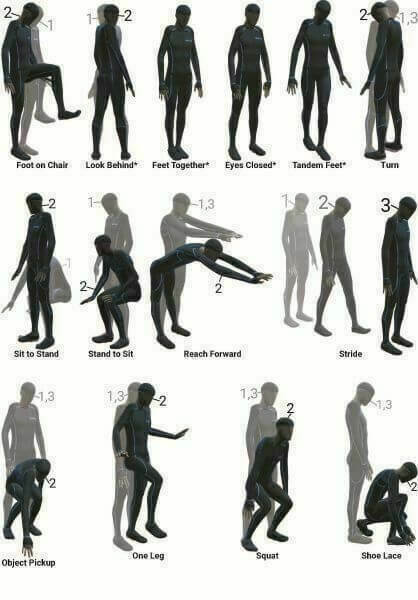
The whole-body center of mass (CoM) plays an important role in quantifying human movement. Prediction of future CoM trajectory, modeled as a point mass under influence of external forces, can be a surrogate for inferring intent. Given the current CoM position and velocity, predicting the future CoM position by forward integration requires a forecast of CoM accelerations during the prediction horizon. However, it is unclear how assumptions about the acceleration, prediction horizon length, and information from ground reaction forces (GRFs), which provide the instantaneous acceleration, affect the prediction.
Researchers
Research Resources and Infrastructure
- Access to clinical partners and community of interest (See People in Michiana).
-
Biomechanics
-
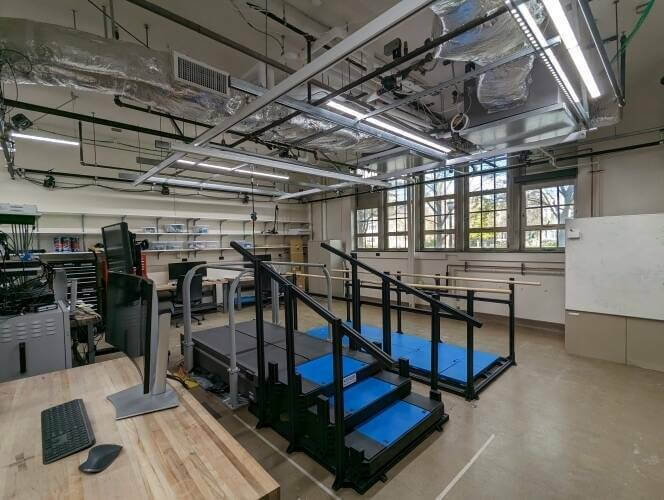
Instrumented treadmill (Split-belt from Bertec)
-
Portable Force Plates 600x500x50 mm (Kistler)
-
Instrumented staircase
-
IMU-based motion capture system (Movella)
-
Marker-based motion capture system (OptiTrack)
-
Portable pressure insoles (Moticon)
-
EMG Trigno System (Delsys)
-
-
Mechatronics
- Composite material 3D printer (Mark Two - Markforged)
- Open Source Leg V2 (University of Michigan and Humotech)
- Direct drives (HEBI Robotics and TQ-Robodrive)
- 6-axis loadcells (Sunrise Instruments)
- Dynamometer (FUTEK)